Backup power in a power cut
General information only. All wiring must be done by a qualified electrician, and your network operator must be told about it.
Does solar keep working in a power cut?
Not on its own. A normal solar system switches off when the mains power goes. That's a safety rule called anti-islanding. It stops your panels sending power into the cables while engineers are fixing them. In Great Britain, the rules for this are G98 for small systems and G99 for bigger ones.
To keep some power on, you need a battery system with backup, often called EPS (Emergency Power Supply).
What EPS is
- EPS is a separate small fuse board (a consumer unit), apart from your main fuse board.
- An electrician wires your essential circuits to it, for example the fridge, some lights, the internet router and the boiler.
- In a power cut, the system disconnects from the grid by itself. It then runs those circuits from your battery and solar.
- How fast it switches: some hybrid inverters switch in under a hundredth of a second (under 10–20 milliseconds), so most devices won't notice. Some other systems take a few seconds, which can make clocks and computers restart.
- Power limit: EPS can only give out so much power at once, often about 3 to 6 kW on a home system. Running the kettle, oven and shower together can trip it. Keep EPS for the things that matter.
- Whole-house backup needs extra equipment, such as a gateway or automatic changeover switch. It also needs a big enough inverter and battery. Ask for this when you get quotes.
What you need
| Part | What it does |
|---|---|
| Solar panels | Make DC power from daylight |
| Battery | Stores DC power for later |
| Inverter | Changes DC into the AC power your home uses |
| Charger (converter) | Changes AC from the grid into DC, so you can charge the battery from the grid on a cheap night tariff |
If you add a battery to a solar system you already have, it's often AC-coupled. That means it comes with its own battery inverter, which does both jobs: it charges the battery and turns its power back into AC.
Hybrid inverters: two jobs in one box
A hybrid inverter turns solar and battery power into AC for your home, and it charges the battery from solar or the grid. So you usually don't need a separate charger.
Many SolaX, Fox ESS and Solis hybrid inverters have an EPS or backup output. Some examples from maker data sheets:
| Model | Backup (EPS) power | Short burst | Switchover time |
|---|---|---|---|
| SolaX X1-Hybrid G4 (3.0 to 7.5 kW) | 3.0 to 7.5 kVA | Up to 11.25 kVA for 10 seconds | Under 10 ms |
| Fox ESS H1 G2 (3.0 to 6.0 kW) | 3.0 to 6.0 kVA | Up to 7.2 kVA for 60 seconds | Under 20 ms |
| Solis S6-EH1P10K-L-PLUS (10 kW) | 10 kVA | Not given | Under 10 ms |
kVA is roughly the same as kW for most home appliances.
Real installs: backup-ready systems
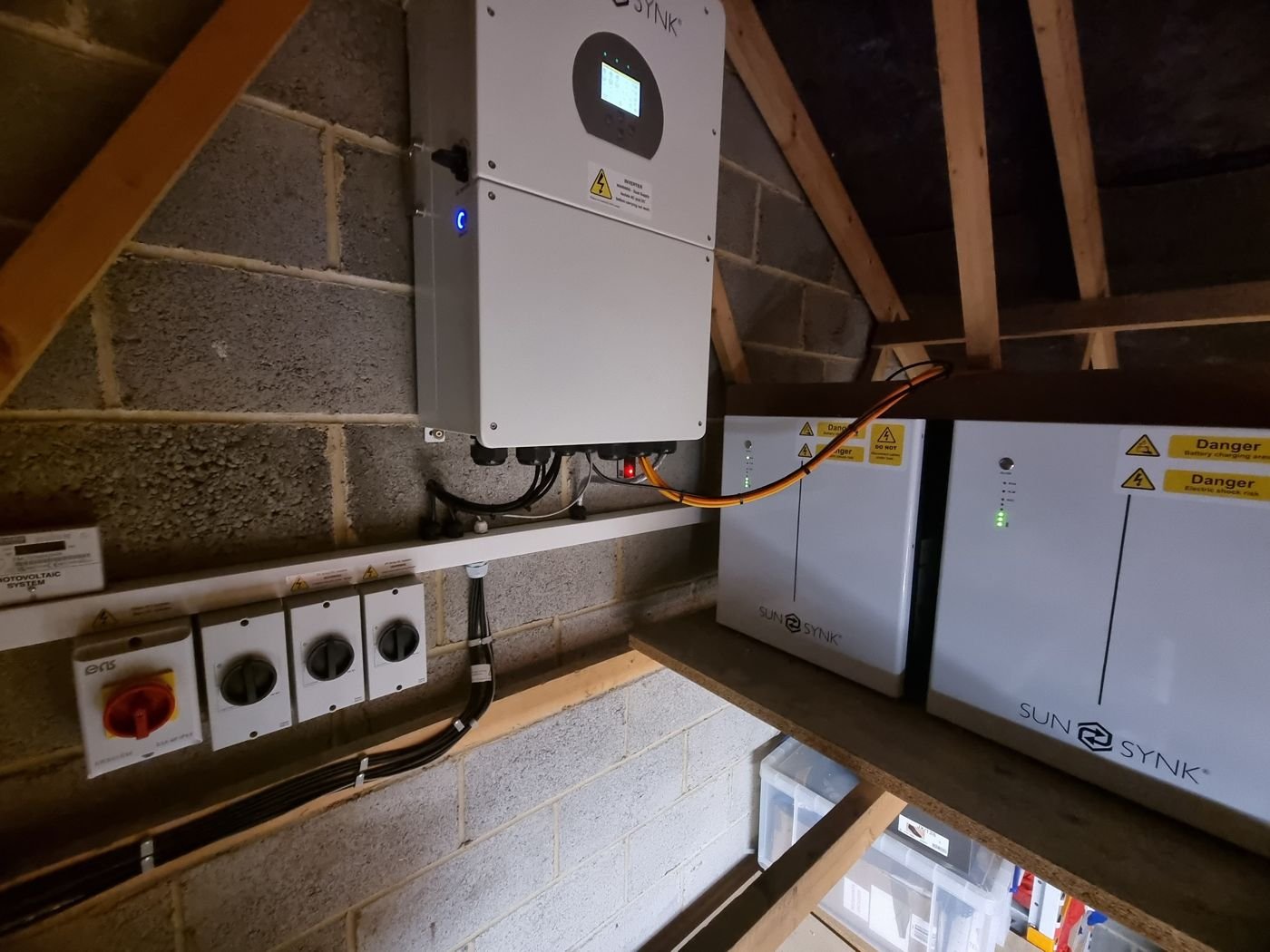
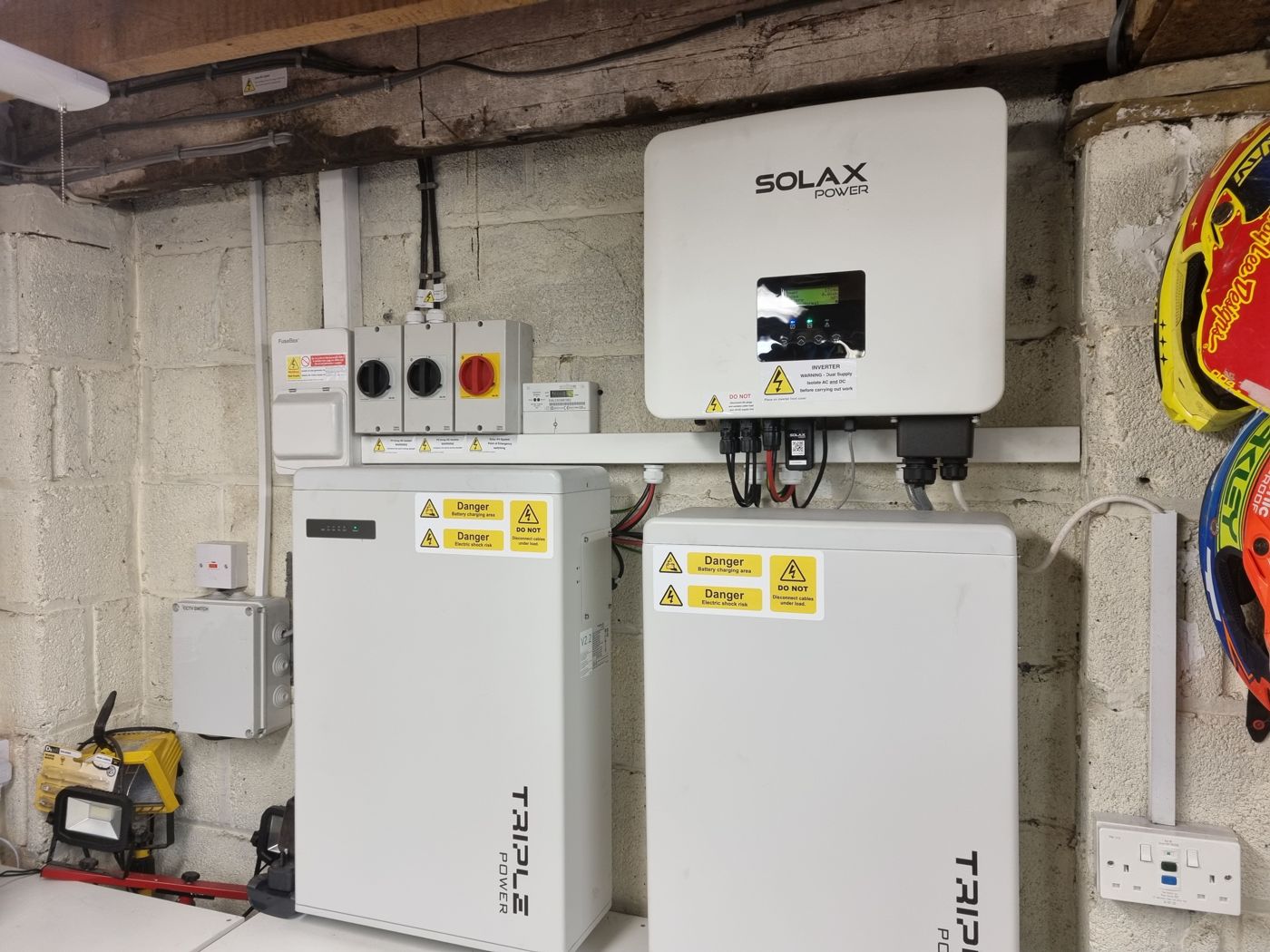
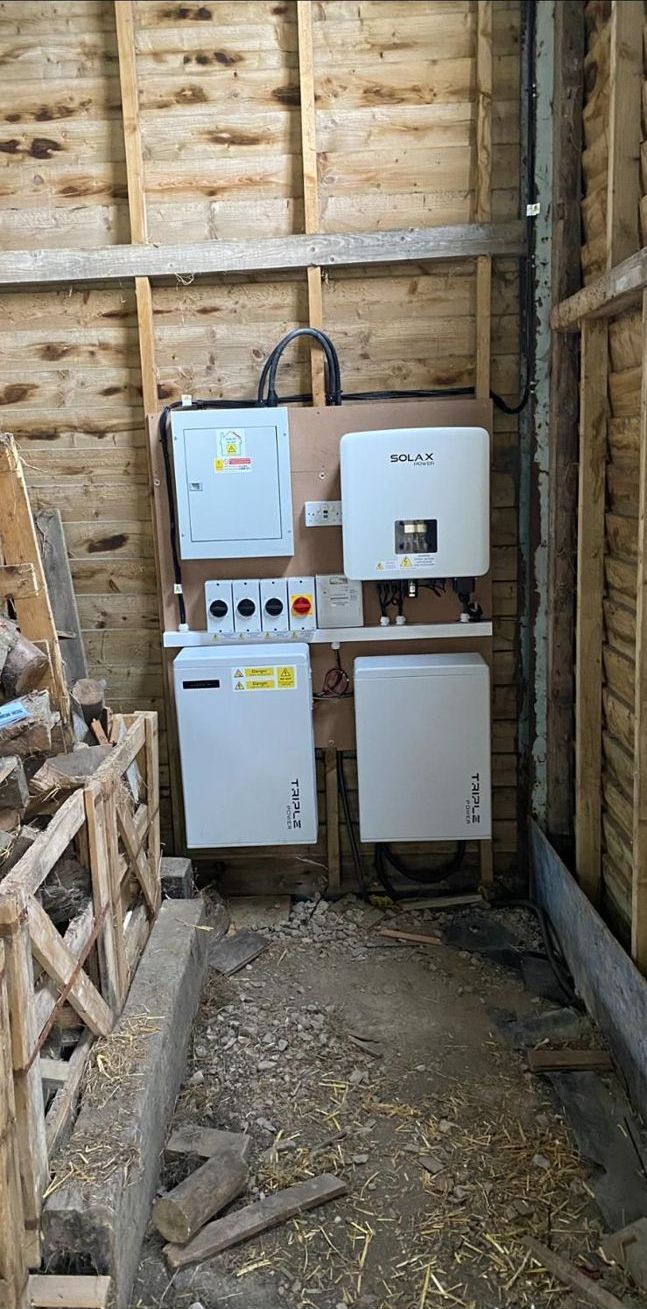
Photos from real UK installs. They show hybrid inverters with batteries in different places around the home.
Questions to ask your installer
- Does the quote include EPS or backup? Is it for chosen circuits or the whole house?
- Which circuits will be on the backup board?
- How much power can it give in a power cut, and how fast does it switch over?
- Will the battery also charge from solar during a power cut?
Where our facts come from
- SolaX X1-Hybrid G4 product page
- Fox ESS H1 G2 user manual (PDF)
- Solis S6-EH1P10K-L-PLUS spec (seller page)
- Energy Networks Association – G98 and G99
Figures are typical and approximate. Last reviewed October 2026.